 Ready to make café-style coffee at home?
Maybe you’re tired of spending $6 on a latte. Maybe you tried a friend’s homemade espresso and thought, “I want that in my kitchen.” Either way, you’re here—and there are a lot of espresso machines to choose from.
No need to feel overwhelmed.
This beginner’s guide to espresso machines breaks down what matters before you buy, without the barista jargon. You’ll learn which type of machine might suit your routine, what extras to budget for, and which common beginner mistakes to avoid.
First things first: What is espresso?
Espresso is made by pushing hot water through finely ground, firmly packed coffee under pressure. A shot usually takes about 25 to 30 seconds to brew. The result is a small, concentrated coffee with a golden layer of foam on top, called crema.
Espresso can be a little particular. Small changes—like the grind size or how firmly you tamp the coffee—can make a shot taste sweeter, more sour, or more bitter.
That’s not something to worry about. It just means you’ll need a little practice, and the right equipment can make learning easier.
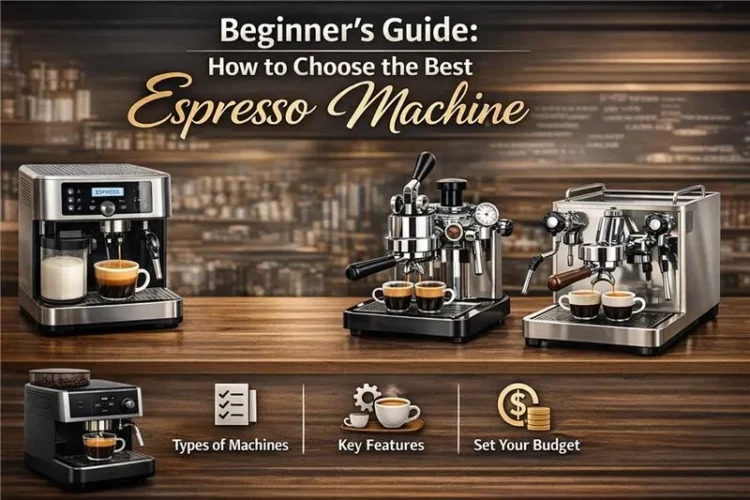
The four main types of espresso machines
Choosing a machine type is one of your biggest decisions.
Here’s a simple guide to what each one is like.
1. Manual machines
With a manual, or lever, machine, you create the pressure yourself by pulling a lever. These machines offer plenty of hands-on control, but they take practice and time.
Think of one as the manual-transmission car of the coffee world. Hand-powered models like the Flair 58 and Cafelat Robot are examples of this style.
Best for: Coffee hobbyists who enjoy tinkering and don’t mind a slower morning routine.
2. Semi-automatic machines
Many beginners choose a semi-automatic machine. You grind and tamp the coffee, while the machine handles the water pressure. You decide when to start and stop the shot.
Popular examples include the Gaggia Classic Pro, Breville Bambino Plus, and De’Longhi Dedica.
Best for: People who want some control without needing a coffee-science degree.
3. Automatic and super-automatic machines
Automatic machines control the amount of water used for each shot. Super-automatic machines do even more: they can grind the beans, tamp the coffee, brew the espresso, and sometimes froth the milk—all at the push of a button.
Some Jura and Philips models, for example, include built-in grinders.
Best for: Busy households where convenience matters more than fine-tuning every shot. These machines usually cost more upfront and can be harder to repair.
4. Pod and capsule machines
With a pod machine, you pop in a capsule, press a button, and you’re done. Nespresso machines are a familiar example of this style.
They’re quick and easy, though the coffee is more “espresso-style” than traditional espresso. You’ll also have less control over flavor and will need to keep buying pods.
Best for: Anyone who wants a quick, low-mess cup and isn’t interested in the brewing process.
Don’t overlook the grinder
If you remember one thing from this guide, make it this: the grinder matters as much as the espresso machine—sometimes more.
Espresso needs a fine, even grind. A basic blade grinder chops beans into uneven pieces, which can lead to weak or harsh shots, even if your machine is expensive.
For example, someone with a $350 machine and a $150 burr grinder will often make better espresso than someone with a $700 machine and a $20 blade grinder.
A few burr grinders that beginners often consider include the Baratza Encore ESP, Eureka Mignon Manuale, and Fellow Opus. Some machines, like the Breville Barista Express, have a grinder built in, which can be useful if you’re short on counter space.
Espresso machine features that matter
It’s easy to get lost in product descriptions and spec sheets. Here are a few features worth paying attention to.
Pressure: 9 bars is what to look for
You might see machines advertised with “15 bar” or “19 bar” pressure. A higher number doesn’t necessarily mean better espresso. Brewing generally calls for about 9 bars of pressure at the coffee, and a good machine regulates it for you.
Heating system: thermoblock, single boiler, or dual boiler
The names sound technical, but the basic difference is simple:
- Thermoblock: Heats water as it passes through, much like a tankless water heater. These systems are common in budget-friendly machines, including the Breville Bambino, and can heat up quickly.
- Single boiler: Uses one boiler for both brewing and steaming. You may need to wait between pulling a shot and frothing milk. The Gaggia Classic Pro is one example.
- Dual boiler: Uses separate boilers for brewing and steaming, so you can do both at once.
- This can be handy if you make lots of lattes, but dual-boiler machines tend to cost more and take up more space.
- Steam wand: useful if you love milk drinks
If you enjoy lattes or cappuccinos, take a look at the steam wand. A manual wand can make café-style microfoam, but it takes practice. An automatic wand, like the one on the Bambino Plus, does more of the work for you.
If you mostly drink straight espresso or Americanos, you may not need to spend extra on milk-frothing features.
Portafilter size
The portafilter is the handle that holds the coffee basket. A 58 mm portafilter is a common commercial size, so you’ll find plenty of compatible accessories. Many home machines use a 54 mm or 51 mm portafilter, which can work just as well, though there may be fewer accessories to choose from.
Pressurized vs. non-pressurized baskets
Many beginner machines come with a pressurized basket. It’s more forgiving and can help create crema even if your grind isn’t quite right yet.
A non-pressurized basket can bring out more flavor, but it also calls for a better grinder and a steadier technique. You can start with a pressurized basket and switch when you feel ready.
How much does an espresso machine cost?
Here’s a rough price guide to help you plan:
- Under $200: Simple pump or pod machines. They can be a fun place to start, but may come with limitations.
- $300–$700: A popular range for beginners, with solid semi-automatic machines and some built-in-grinder options.
- $800–$2,000: More advanced home machines, including models with dual boilers or more precise temperature control, as well as some super-automatics.
- $2,000 and up: Higher-end machines for serious coffee enthusiasts.
Prices change, so check current listings before you buy.
Remember to budget for accessories, too. You might spend another $100 to $300 on items such as:
- A burr grinder, if your machine doesn’t include one
- A tamper that fits your portafilter
- A milk pitcher
- A scale and timer
- A knock box for used coffee grounds
- Descaling solution and cleaning tablets
Think about counter space and cleaning.
Before you fall in love with a machine, measure your counter. Some espresso machines are taller or deeper than they look in photos. Check that it will fit under your cabinets, including room to open the water-tank lid.
It’s also worth thinking about how much cleaning you’re comfortable doing. You’ll generally need to wipe the steam wand after use, rinse the portafilter, and descale the machine regularly. How often you need to descale depends partly on your water.
If you’d rather keep maintenance simple, look for a machine with easy-to-remove parts, such as the water tank and drip tray.
Which espresso machine might suit you?
“I want a morning latte, but I’m busy.” A super-automatic machine or a semi-automatic with an automatic steam wand, like the Breville Bambino Plus, may make your routine easier.
- “I enjoy gadgets and want to learn.” A semi-automatic machine like the Gaggia Classic Pro, paired with a good grinder, gives you room to experiment.
- “My kitchen is tiny.” Consider a compact model like the De’Longhi Dedica, or a manual machine that can be stored away.
- “I’m not sure I’ll stick with it.” A capsule machine or budget-friendly semi-automatic can be a lower-commitment way to start.
Common beginner mistakes to avoid
- Skipping the grinder. A good grinder can make a noticeable difference in the cup.
- Using old or pre-ground coffee. Fresh beans—ideally roasted within the past month or so—can make your espresso taste brighter.
- Buying the machine with the most buttons. More features can mean more to learn. A simple machine may be a better fit.
- Expecting perfect espresso on day one. Your first shots might taste sour or bitter. That’s normal. Try changing one thing at a time, like the grind size, and keep notes.
- Forgetting about maintenance. Coffee oils and mineral buildup can affect how your machine works and how your espresso tastes.
A quick checklist before you buy
Ask yourself:
- What do I actually drink—espresso, lattes, or both?
- How much time do I want to spend making coffee each morning?
- Does my budget include a grinder and accessories?
- Do I have enough counter space, and am I comfortable with regular cleaning?
- Does the brand offer a good warranty or local support?
If you can answer these five questions, you’ll have a much clearer idea of what to look for.
Final thoughts
Buying your first espresso machine should be exciting, not overwhelming. Choose something that fits your routine, set aside room in your budget for a decent grinder, and give yourself time to learn.
Every home barista starts somewhere—and a few sour shots are part of the process.
Have a question about choosing your first espresso machine? Leave it in the comments.
We’d love to help you find the right fit.